-
Thank You, Central Saanich

I am writing at 1:17 in the morning, and I know I will have more to say later. For now, I wanted to get something out there for when the sun comes up.
I am so honoured by the trust that so many people in Central Saanich have placed in me. I am deeply grateful, and I am hopeful about what we can build together.
Tonight’s preliminary results show me elected Mayor with 3,616 votes, in a close race with Pat Bryant, who received 3,257.
I want to thank Pat and his team for running a good campaign and for putting forward their ideas for our community. Elections ask a great deal of candidates, their families and volunteers, and I appreciate the work they put into this one.
I also want to recognize everyone who put their name forward for Council and School Trustee, including those who were not elected. Running for public office takes courage, time and a willingness to put yourself out there. Our community is better when people are prepared to do that.
We will also have several new faces around the Council table. I look forward to the fresh ideas and energy that a new Council will bring, along with the experience of those returning. It will also be the first Council with a majority of women since I was first elected in 2002, which is wonderful to see.
For me, this result is both an honour and a responsibility.
Throughout this campaign I have talked about being available, listening, and working with people rather than simply for them. That does not end with an election.
I will work every day to be accessible, to listen carefully, to ask questions, and to work with Council and with people throughout Central Saanich.
Thank you to everyone who voted, everyone who volunteered, everyone who opened a door, came to a coffee conversation, asked a difficult question, offered an idea, or simply took part. I am so honoured, so grateful, and so hopeful for what we can build together.
-
Small Things Add Up

Not everything I’ve worked on at Council has been a big policy debate.Some of the things I’m happiest to see are much more ordinary: a sidewalk where there wasn’t one, a safer crossing, a better bus stop, or a trail connection that makes it easier to walk somewhere.
Over the years I’ve pushed for pedestrian safety improvements around Stelly’s Cross Road and Mt. Newton, better transit access, and safer connections between neighbourhoods.These things matter because Central Saanich has changed. There is more traffic, more development, and more pressure on roads that were not designed with pedestrians in mind.
We need more sidewalks and more safe places for people to walk.
That will be one of my primary objectives if I am elected Mayor.
It is not flashy work. But if you are walking your child to school, trying to get to a bus stop, or simply trying to cross the road safely, it matters.
-
Thanksgiving Thoughts

Thanksgiving is a good time to remember how much of Central Saanich runs on volunteers, goodwill, and people who keep saying, “I can help with that.”
I think of the volunteers with Peninsula Streams, the people who worked to preserve the old schoolhouse, put on Music in the Park, and those with the Saanich Inlet Protection Society. I think of the Central Saanich Seniors’ Centre, which my grandmother helped start, and all the people who have kept it going since. I think of the volunteers who made the community garden such a success, and Farmlands Trust, where people grow food and give it to soup kitchens and others who need it.
There are many more.Municipal government gets attention, but much of what makes a community work happens because somebody says, “let’s make this happen.” Then they discover that this may involve a meeting, a shovel, a grant application, some folding tables, and more time than expected.
Central Saanich’s motto is “The Land of Plenty.” Thanksgiving seems like a good time to think about that too.
We are lucky to live in a place with rich farmland and people who produce food here. So I am also thankful for our farmers, for the food they grow, and for the abundance around us.
There is a lot to be thankful for in Central Saanich.
-
Zeb King published From Early EV Advocacy to a Community Strategy in From the Campaign 2026-10-09 08:47:46 -0700
From Early EV Advocacy to a Community Strategy

This photo is from December 2018, with Mayor Ryan Windsor, Norm Doerksen, and me, during a period when Central Saanich was starting to take electric vehicles and charging infrastructure much more seriously.
I had already been pushing the issue for a few years.
In July 2016, I brought forward a Notice of Motion asking Central Saanich to explore a Level 3 fast charging station, potentially as a public amenity connected with new development.
By February 2018, Council had directed staff to look at a community-wide EV charging strategy, including charging infrastructure in new developments and incentives for retrofitting existing buildings. The District’s later EV and E-Bike Strategy records that direction. Central Saanich EV and E-Bike Strategy Central Saanich
Around that time, I was also pushing for EV-ready infrastructure in multi-unit buildings, an electric vehicle in the municipal fleet, and better public charging.
The work kept moving.
By 2019, Central Saanich had added electric vehicles to the municipal fleet, introduced Modo carsharing with an EV, and installed more charging infrastructure.
In 2020, Mayor Ryan Windsor, Councillor Chris Graham and I jointly brought forward a Notice of Motion called “Accelerating Transportation Electrification — A Select Committee for 2020.”
We proposed creating a short-term committee so that people from the community and people with expertise in electric vehicles could help shape the District’s emerging strategy.
That committee was established. The District later described the strategy as being developed in consultation with the EV and E-Bike Strategy Committee, made up of residents and people with expertise in the field. Central Saanich climate action page Let's Talk, Central Saanich
The strategy that emerged included more than 30 actions, including more public charging and EV-ready requirements for new construction. By the end of 2020, the District reported that those new-development charging requirements had already been adopted. Central Saanich 2020 Year in Review Central Saanich
This is another good example of how municipal concepts turn into reality. They start with an idea, other councillors eventually join the effort, residents and experts contribute and staff put together the detailed work.
PNR article from 2018: https://peninsulanewsreview.com/2018/02/12/more-car-chargers-are-in-the-works-for-central-saanich/
-
Protecting the Right to Speak Up

(Zeb speaking to delegates of the UBCM regarding his Anti-SLAPP resolution)
One of the things I have cared about for a long time is making sure people can participate in public debate without being intimidated into silence.
In 2017, I brought forward a resolution through Central Saanich calling for stronger protection against Strategic Lawsuits Against Public Participation, or SLAPPs.
These are lawsuits that can be used to discourage people, community groups, journalists and even local governments from speaking out on matters of public interest.
Our resolution went to the Union of BC Municipalities. Because it was a late resolution, I first had to stand up and make the case for why delegates should even agree to consider it.
Then I got to advocate for it before representatives from municipalities across British Columbia.
I loved that part of it. You make your case, people debate it, and then everyone votes.
We got it passed.
That was important because a resolution from me, one councillor, became a council resolution at the UBCM and had now become a position endorsed by municipalities from across British Columbia. UBCM records the Central Saanich resolution as endorsed in 2017.
After the vote, I also spoke briefly with the Attorney General about it. He thanked me for the anti-SLAPP resolution and said legislation would be on the government's agenda. The Province later introduced the Protection of Public Participation Act.
The Act passed and received Royal Assent on March 25, 2019. It created a process allowing courts to dismiss proceedings that arise from expression on matters of public interest unless the person bringing the case can meet the tests set out in the law, including showing substantial merit and sufficiently serious harm. BCLaws
I like this example because it shows what can start at a municipal Council table.
You can start with an issue in your own community, persuade your Council, take it to municipalities across the province, and help add another voice to a movement that eventually changes the law.
For me, the principle behind it is still pretty simple: people should be able to speak up about public issues without being frightened into silence or bullied into toeing a line.
UBCM resolution: Strategic Lawsuits Against Public Participation
-
Looking Back at Keating


(The dotted line was proposed for an expansion of the industrial lands. The pink lots were getting farm tax status.)
Following Council’s recent decision to approve the rezoning of the Keating extraction lands, I thought I would share this old video from years ago which again shows the community's values about agricultural land and containing sprawl.
While we were all much younger, the video captures some of the history behind the conversations we are still having today about growth, farmland, industrial land and the future of Keating.
At that meeting, I argued against expanding the Urban Containment Boundary and creating a new “future growth area” and residents spoke very passionately. I also raised concerns about farmland, food security and the consequences of the decisions we make for future generations.
What I also like about the video is that it preserves many different voices.
Residents came forward with questions about transportation, water, servicing costs, agriculture, housing and development. Councillors had different perspectives too. Some of those councillors have since retired. Some are running again. Residents who spoke had their own views and experiences.
All of them are part of the history of the area.
At one point a resident asked a series of questions about the costs and consequences of future development. My answer was simply that we did not know because we had not yet done that work.
The research hadn't been done, but there were councillors who were prepared to keep the expansion on the table as a long-term option.
At 19:26, one councillor said:
“I think the future growth area is a good idea. This is not about development tomorrow. This is about long-term planning with the potential... of something happening in the future.”
I took the opposite view. I argued that expanding the Urban Containment Boundary would encourage sprawl, that there was already room for growth within the existing industrial area, and that farmland and food security had to be protected.
In the end, Council did not extend the containment boundary out to the larger area being contemplated. The boundary remained generally where the purple line is on the map above.
Looking back, I am glad I argued to hold that line.
Can you imagine if the boundary had been expanded to the dotted line?
These consequential debates do not begin with one rezoning application or one Council vote. They build over many years.
It's never over. The discussions and debate continue to shape the choices in front of us today.
Watch the video from the earlier Keating growth discussion

-
Zeb King published Working Together on Electoral Boundaries in From the Campaign 2026-10-04 15:58:34 -0700
Working Together on Electoral Boundaries

We are in the unusual situation of having two elections underway at the same time, one municipal and one provincial. It can get a little confusing.
It also has me thinking about electoral boundaries.
At the municipal level, I was happy to work with Councillor Niall Paltiel in 2022 when the BC Electoral Boundaries Commission was considering changes that would have moved Brentwood Bay into the Saanich South provincial riding.
Niall and I jointly brought forward a motion asking Central Saanich to make a submission to the Commission.
The motion said:
WHEREAS the BC Electoral Boundaries Commission was seeking advice about proposed boundary changes before its November 22, 2022 deadline;
WHEREAS the village of Brentwood Bay was proposed to become part of the Saanich South electoral area; and
WHEREAS Central Saanich Council and the District have a unique local understanding of the cultural and historical identity of Brentwood Bay which should inform the Commission’s decision;
THEREFORE BE IT RESOLVED that Central Saanich make a submission to the BC Electoral Boundaries Commission recognizing the importance of Brentwood Bay’s village identity, its cultural and historical connections, and the relationship between Brentwood Bay and Tsartlip First Nation.
The motion was jointly submitted by Councillors Zeb King and Niall Paltiel and Council supported making the submission. November 14, 2022.
I am glad we worked together on it. It is a small example of collaboration making a difference.
But collaboration does not mean unanimity, and it does not mean every vote has to go your way. Sometimes you lose a vote. Sometimes you are the dissenting voice. That is part of democracy too. What matters is being willing to make your case, listen to others, find common ground when it is there, and accept disagreement when it is not.
-
Zeb King published A Different Approach to Leadership in From the Campaign 2026-10-03 00:14:04 -0700
A Different Approach to Leadership

One of the questions at the All Candidates Meeting was about public participation.
It is something I have thought about, studied and worked on for years.
There is a useful framework developed by the International Association for Public Participation. It describes a range from simply informing people, through consulting, involving and collaborating with them, all the way to empowering the public to have a much greater role in decisions. IAP2 Canada
I have already brought a motion to Council asking us to explore how Central Saanich could move further along that spectrum. That motion was referred to the next Council.
For me, this connects directly with the approach to leadership I have studied with Dr. Marshall Ganz at the Harvard Kennedy School and continue to practise through the Leading Change Network.
The idea is simple. Leadership is not about having all the answers. It is about listening, building relationships, finding common purpose and helping people act together when things are uncertain.
I would like to see more opportunities for residents to take part meaningfully, whether through town hall forums, citizens’ assemblies, or advisory bodies that are actually supported.
Public participation should be more than being told what has already been decided.
We can do better than that.
-
Work to Reconcile

When I was first elected in 2002, there was no Orange Shirt Day and no National Day for Truth and Reconciliation. Orange Shirt Day began in 2013, and the National Day for Truth and Reconciliation was established federally in 2021. Orange Shirt Society
My interest in building relationships with Indigenous people came from believing that local government had a responsibility to build better relationships.
Early in my time on Central Saanich Council, I helped initiate Community-to-Community Forums with Tsawout and Tsartlip. At the time, there had been too little communication between our councils. The work began quite simply: going to meet people, talking, getting to know one another, and making clear that this was not going to be a one-time exercise.
That experience was later included as a case study in the Guide to Community to Community Forums in British Columbia. The guide describes how we held some of those early meetings in one another’s homes rather than at Municipal Hall, because building relationships mattered as much as holding the formal forum itself.
That relationship-building also led to practical work. I worked with Mavis Underwood and others to bring the issue of bus service into Tsawout to the Greater Victoria Transit Commission. The bus had been going past the community. Today it goes in. Gwen Underwood later recalled both the Council-to-Council work and the importance of getting that transit connection established.
The work continued. In 2015, I brought forward a motion calling for Central Saanich to initiate another formal meeting with Tsartlip and Tsawout, including pursuing Community-to-Community Forum funding. Central Saanich Meetings In 2016, I also brought the Truth and Reconciliation Commission’s Calls to Action before Central Saanich Council, and Council unanimously supported moving ahead with work on the recommendations relevant to local government.
I do not mention these things because I think reconciliation is something that can be checked off as accomplished, or for political point scoring.
I mention them because Orange Shirt Day gives us a chance to reflect not only on history, but also on relationships and what we actually do with what we have learned... all of us.
For me, that work has always been about what happens between commemorative days: showing up, listening, building trust, learning from one another, and finding practical ways to work together.
That work is not finished, and it matters what we do next.
-
Zeb King published This Decision Belongs to the Next Council in From the Campaign 2026-09-28 16:49:08 -0700
This Decision Belongs to the Next Council

Tonight is the second-last scheduled regular Council meeting before the municipal election.
If this Council moves tonight to lock in the sale of municipal lands or establish binding contracts connected with the Municipal Hall project, I believe that would be an outrageous act against the best interests of local democracy and this community.
We are only weeks from an election. Central Saanich residents are being asked to choose the Council that will govern the community for the next four years.
A decision of this magnitude should not be rushed through in the waning hours of the current Council’s mandate.
I have been clear about my concerns with the proposed Municipal Hall project. Others disagree with me. That is precisely why the democratic process matters. To move forward will do harm to what is left of the public's trust in this council.
The incoming Council should be able to consider the options, examine the financial implications, hear from the community and make its own decision without finding that the outgoing Council has already bound its hands.
A verdict on the Municipal Hall and the future of our public lands belongs to the next Council.
Not tonight.
-
Zeb King published Experience with Knowing About Process in From the Campaign 2026-09-27 23:54:12 -0700
Experience with Process
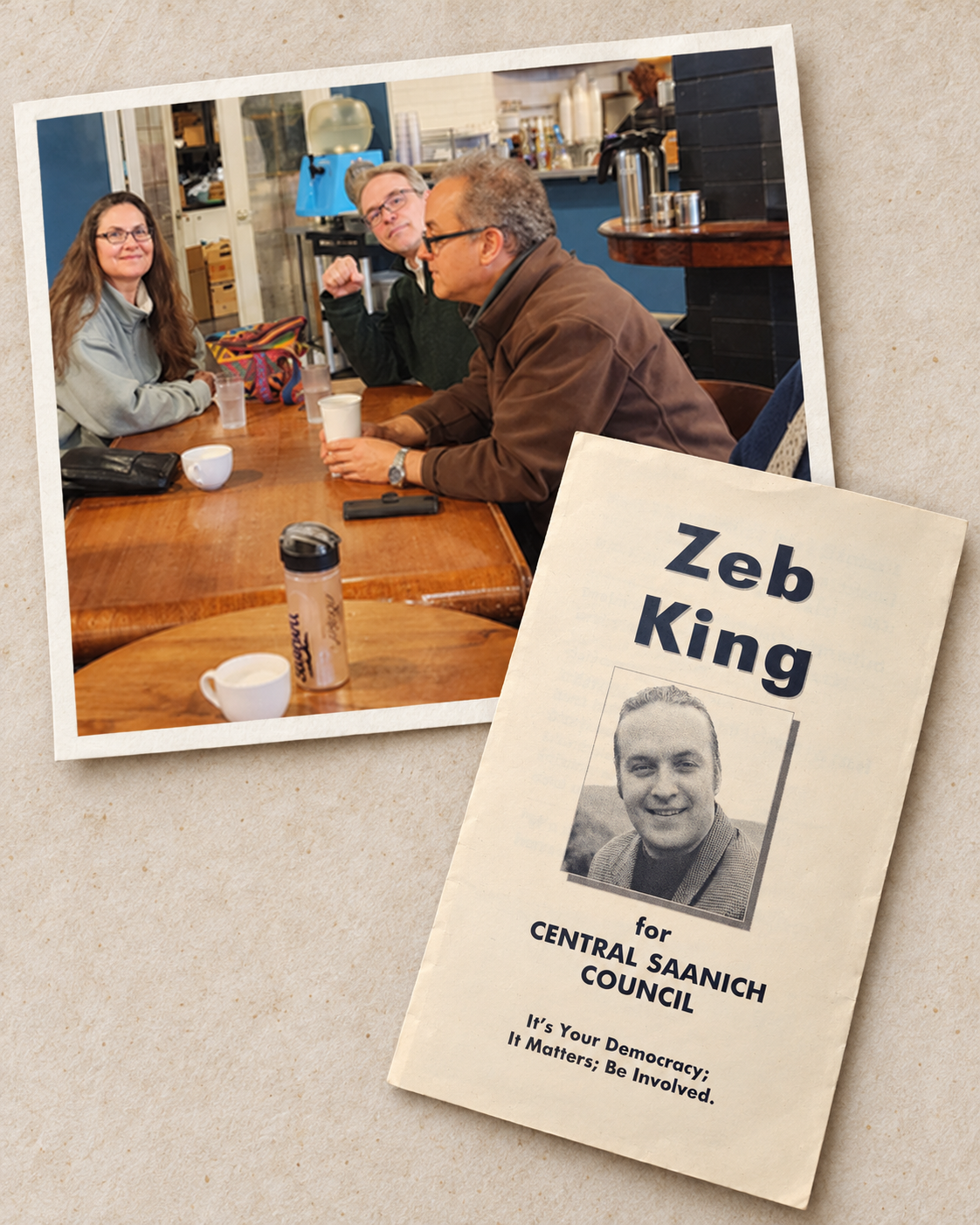
Over the years, I’ve tried to make “asking one more question” something I actually do, not just something I talk about.
I pushed for Council meetings to be webcast so more people could follow decisions. I’ve held regular drop-ins so residents can bring concerns directly to me. And I’ve brought forward motions when I thought Council needed more information before making a decision.
Good process means making it easier for people to be heard, and being willing to ask another question before deciding.
-
A tree with a story

When my younger brother was born, my mom planted a spruce tree that was about the same length as her new baby boy.
As we grew up, we watched the tree grow too. It wasn't just another tree. It had a story attached to it.
Years later, I thought about what it would be like if every newborn baby in Central Saanich had a similar story. What if a family planted a tree for their baby and watched the tree grow as their child grew?
I think having a story attached to a tree changes the way we see it. It becomes less likely that we will simply chop it down without much thought. It means something to us.
That thinking eventually led me, as a councillor, to initiate Central Saanich Tree Appreciation Day in 2014.
The District continues to hold a planting event, which is great. But my hope has always been that Tree Appreciation Day would grow beyond a municipally sponsored event and become a wider community tradition. Families, neighbours and community groups can plant trees and create their own stories.
The spruce my mom planted is now about fifty years old. It won't live forever, but it has a different significance because it went from being another tree to being a tree with a story attached to my brother.
Tomorrow is Tree Appreciation Day in Central Saanich. The District will be holding its annual tree planting, and I'll be there.
But Tree Appreciation Day doesn't have to happen only at a District event. Maybe tomorrow is also a good day to plant a tree of your own.
Give it a story. Then watch it grow.
-
Zeb King published Something Hanke Taught Me 21 Years Ago in From the Campaign 2026-09-24 22:27:01 -0700
Something Hanke Taught Me 21 Years Ago

Dominion Astrophysical Observatory at night. Image courtesy of the Centre of the Universe.Twenty-one years ago, during my first term on Council, I was holding my weekly coffee chat at JJ's Café in Brentwood Bay.
A senior named Hanke came by and talked to me about light pollution.
I hadn't given the issue much thought. He explained that unnecessary light at night doesn't just make it harder to see the stars. He also told me about research into artificial light and our natural circadian rhythms.
I went away and learned more. Between January and March 2005, I brought three memoranda to Council about light pollution.
We have a particular reason to think about the night sky here. Just south of Central Saanich is the Dominion Astrophysical Observatory, and protecting the night sky matters for astronomy as well as for those of us who simply enjoy looking up at the stars.
The science has also developed considerably since Hanke first spoke with me. We know that artificial light at night can affect circadian rhythms, although researchers continue to study how ordinary outdoor lighting affects human health.
There are people doing practical work on this today. DarkSky International works to protect the night from light pollution, and the Royal Astronomical Society of Canada, Victoria Centre has a local Night Lighting program with information about reducing unnecessary outdoor light.
I like remembering how this one started.
A resident came to my coffee chat and told me about something I knew little about. I listened, learned more, and took it to Council.
Twenty-one years later, I'm still learning from people who come to talk with me at my cafe chats or elsewhere.
-
Zeb King published Experience Working Collaboratively in From the Campaign 2026-09-23 22:59:14 -0700
Experience Working Collaboratively

Years ago, a Tsawout resident named Lois came to me with a concern. The bus went past Tsawout First Nation lands, but didn't go into the community.
I reached out to Tsawout Councillor Mavis Underwood. Together, we took the issue to the Greater Victoria Transit Commission and asked for better service.
Today, the bus no longer simply passes by. It goes into the community, helping people get to work, medical appointments, shops, or to meet friends.
It started with one person raising a concern, and people from different communities working together to make change happen.
That collaboration is something I've always been proud of.
As your Mayor, I would be committed to improving transit by organizing people in our community to get the changes we need.
-
Zeb King published Before We Rezone, What Can We Secure for Our Community? in From the Campaign 2026-09-22 22:35:10 -0700
Before We Rezone, What Can We Secure for Our Community?


Central Saanich is considering rezoning a large area of the Keating extraction lands to light industrial.I don't think we need to rush this decision.
We already know that one of the challenges facing local agriculture is access to food-processing infrastructure. Central Saanich commissioned a Food Hub Feasibility Study that identified the need for more meat-processing and abattoir capacity in our region. (p. 31)
Facilities like these need appropriate land. Industrial land is expensive.
That raises a pretty basic question for me.
Why would we rezone this large area first, and only afterwards try to find affordable industrial land for a food hub?
Once the land is rezoned, a community food hub could find itself competing for land with much larger commercial and industrial interests. How many bake sales would it take for a publicly supported food hub to buy several acres of newly rezoned industrial land?
We have an opportunity now, before rezoning, to explore whether land could be secured for food processing or other community purposes as part of discussions with landowners.
I'm not opposed to light industrial uses here. In fact, our Official Community Plan has contemplated the eventual transition of these extraction lands toward light industrial use for years.
But this is a large area with enormous potential. The current Council does not have to settle every question about its future in its final meetings.
Before we rezone, let's find out what we can secure for the community.
Once the rezoning is complete, that opportunity may be much harder, and much more expensive, to recover.
Read the Central Saanich Food Hub Feasibility Study – Final Report (2022).
-
Zeb King published A Community for All Ages and Abilities in From the Campaign 2026-09-21 22:53:17 -0700
A Community for All Ages and Abilities

My years on Council have shown me that the same community can look very different depending on who is experiencing it.
In 2022, I brought forward a motion for Central Saanich to seek grant funding to develop an Age-Friendly Community Plan. Council supported it, we received the grant, and I later had the privilege of chairing the committee.
At our first meeting, one of the questions I was asking was, who isn't yet in the room? I wanted the Central Saanich Senior Citizens' Association represented, but I also wanted a youth voice included.
That matters. If we're trying to understand how people experience their community, we need to hear from people with different experiences.
Can an older person safely cross the street? Can someone using a wheelchair or walker get where they need to go? Is there somewhere to sit and rest? Can everyone actually use our parks and public spaces?
Accessibility shouldn't be something we think about after we've made a decision or built something.
We still have barriers to remove. This week, think of one place in Central Saanich that is difficult or unsafe for you or someone you care about. Send me a message with the location and what you think would make it better. I want to hear from you.
-
Zeb King published Holding on to a little of our history in From the Campaign 2026-09-19 00:07:06 -0700
Holding on to a little of our history
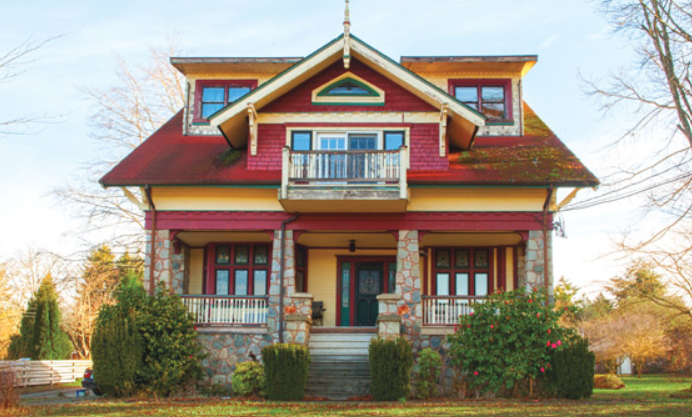
Photo: Seaside Magazine, 2017
Central Saanich doesn't have a great many old heritage homes. Our community was much less developed than places like Victoria, Oak Bay or Esquimalt, so the buildings that remain are particularly important.Years ago, when Matt Peulen and Stride Properties came before Council with a development near Stelly's, I pushed to preserve Verdier House rather than see it disappear with the development.
The house was retained and still stands there today.
Twenty-one years on Council has given me a long view of decisions like this. Development proposals come and go, but what we decide to keep can be with the community for generations.
-
Nearly fifteen years ago...

Signs start going up this weekend, and I came across this old video.
This was me nearly 15 years ago, running for Central Saanich Council and looking for some help putting up signs.
I'm running for mayor this time, not councillor, so I should make that part clear. But I thought the video was worth pulling out again. It's a younger Zeb, and a reminder that I've been at this for a while. I've loved being involved in our community and have been honoured to serve.
Over the years I've had the chance to work with and watch four different mayors. I've seen different ways of leading a council, what works and what doesn't, and I've learned from all of them.
This weekend, we'll be putting up signs again.
And yes, we could still use some help.
Read more
-
Nearly fifty years ago

In 1979, my grandmother, Lea King, put her name forward for Central Saanich Council.
I recently pulled out her old campaign leaflet. This line stood out for me:
“I am dedicated to the maintenance of the natural setting of our rural community, to keeping our farmlands as farmlands and our inlets and bays clean and free of contamination.”
Nearly fifty years later, I could say much the same thing. I too am dedicated to protecting the natural setting of our community, our farmland, and the waters around us.
It is interesting to see those words on a piece of paper she folded up and handed out in 1979.
Different generation, but a commitment I share.
-
An opportunity we could lose

With farmer and former Central Saanich Mayor Jack Mar, holding carrots grown on the farm.
Central Saanich has more than 200 farms, but our own Food Hub Feasibility Study identified a challenge: growing food is only part of the equation. Farmers also need access to processing, storage, equipment and other infrastructure.
When plans for the Keating extraction lands came forward, I saw an opportunity.
Rather than commit all of this land to other uses, I proposed that we identify and preserve space for a food hub. Council didn't support my motion.
But the story isn't over.
These lands come back to Council on September 28.
We have a choice. We can make decisions now that may close off this opportunity, or preserve room for something that could strengthen local farming and food security for decades.
We did the study. We know there is a need.
On September 28, we decide whether to leave the door open.